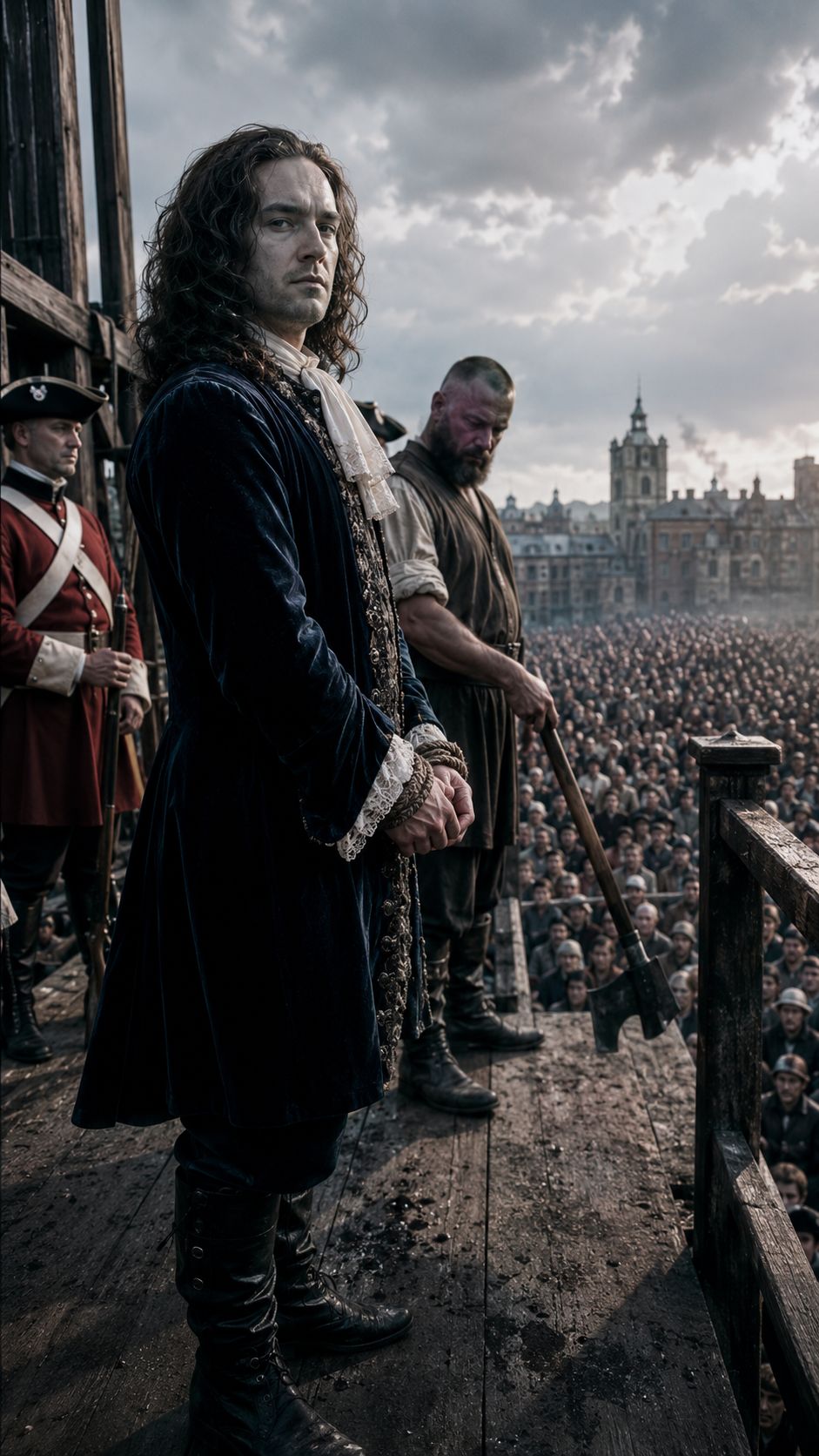
Henri de Talleyrand-Périgord, Comte de Chalais, was born in 1599 and had a courtier’s career: soldier at the siege of Montauban in 1621, then head of the King’s Wardrobe under Louis XIII. He was also a man of quick temper. He killed his wife’s lover in a duel. In 1626, at 26 or 27, he was executed at Nantes for conspiring against Cardinal Richelieu, in one of the worst beheadings on record.
The Horror
The plot, now called the Chalais conspiracy, centred on the king’s younger brother, Gaston, Duke of Orléans, who was unhappy with his planned marriage, and on the Duchess of Chevreuse, an enemy of the Cardinal. The aim was to get rid of Richelieu. According to one account, the plotters also meant Louis XIII to die, so that Gaston could take the throne. Chalais’s part was the most dangerous one. He was to stab Richelieu with his sword at the Cardinal’s house at Fleury-en-Bière, in the course of a staged quarrel among Gaston’s gentlemen while Gaston was visiting.
It did not work. Chalais confided in his uncle, who told him to confess to the king and the Cardinal, and he was then used to spy on the plot. Gaston, when questioned, confessed and named his accomplices. Chalais was arrested on July 8 after a former friend, Louvigny, denounced him. The court had moved to Nantes while the Estates of Brittany sat, and he was tried at the Cordeliers convent there. He confessed in full and was sentenced to death for lèse-majesté, the crime of injuring the king’s person or authority. One source gives the sentence date as July 18. Other sources give it differently, so treat the date as uncertain.
Gaston, the prince at the centre of the plot, was not the one who died.
The execution was set for the Place du Bouffay in Nantes, on August 19, 1626. What happened next is where the sources agree on the outline and part company on the detail. His friends, the accounts say, persuaded the town’s executioner to refuse the job, or bought him off. The hope, presumably, was that without a headsman the sentence could not be carried out and a reprieve might follow. It did not work. A man who was himself under sentence of death was found and pardoned on condition that he do the beheading.
He was not good at it. He first used a sword, bought on the spot, described in one account as a Swiss sword. When it failed he took up a doloire, the broad-bladed axe or adze used by carpenters and coopers. The counts of blows differ. Wikipedia’s article on the conspiracy has Chalais still alive at the twentieth blow and dead at the twenty-ninth or thirtieth. A popular execution blog says two blows with the sword and thirty-four with the adze, and that the man had to turn the body over to finish severing the neck. Wikipedia’s biography of Chalais says “over 30”. The blog quotes a passage without naming where it comes from, and the biography article marks its own figure as resting on a possibly self-published page. No contemporary French source for any of these numbers has been found, so the exact count should be treated as tradition. The common thread is that he was beheaded not in one stroke but across a long, ugly sequence of them.
The blog also records that Chalais cried out “Jesus, Maria et Regina Cali!” until about the twentieth blow. This is a single weak source, and it does not make clear who spoke. It is included only as reported.
The Legend
It is often added that Richelieu personally forbade any delay, and that the bungled death was his lesson to the nobility. No source for either claim has been found. They may be a fair reading of Richelieu’s politics, but they are interpretation, not record, and they are not stated in the sources below. The plan to stall the execution by removing the headsman is itself an account found in these sources without a named original witness.
The Modern Relic
The Place du Bouffay is still a square in the old centre of Nantes, and it is named in these accounts as the place of execution. No plaque or memorial to Chalais at the Place du Bouffay has been found, and its present appearance has not been confirmed. Anyone planning a visit should check on the ground.
The more lasting relic is his reputation. Chalais is remembered in the English-speaking world less for his plot than for the way he died, and the case sits in the long record of Richelieu’s reign as an example of how far the Cardinal’s government would go against those who plotted against it. The nobles who survived the affair, including Gaston, were treated very differently.