Thomas Arthur de Lally was born at Romans in the Dauphiné in 1702, the son of an Irish Jacobite who had followed the exiled Stuarts into French service. He joined the French army in 1721, fought at Fontenoy, and went with Charles Edward Stuart’s expedition to Scotland, serving at Falkirk in 1746. He was brave and capable, and he was also blunt and quarrelsome, qualities that were bearable while he was winning. In 1758 France sent him to India to drive out the British. Eight years later Paris beheaded him for it.
The Horror
Lally reached Pondicherry in April 1758 with too few men and too little money. The campaign went badly. He failed at Tanjore, withdrew from Madras when the British reinforced it, and was beaten at Wandiwash in 1760 by Sir Eyre Coote. Pondicherry itself surrendered in January 1761, which ended France’s hopes of an Indian empire. The surrender date is given as January 16 by two sources.
He was taken to Britain as a prisoner of war. There, in September 1761, he heard that he was accused of treason in France. He could have stayed under British guard. He asked instead to return on parole to answer the charge, against advice, and the choice cost him his life.
The trial began in 1764, after nearly two years of detention, and ran for about two more. By the account in Wikipedia he was given no defence lawyer and was not shown the charge documents. The 1911 Britannica, writing with no great sympathy for his temper, still calls the outcome “undoubtedly a judicial murder”. The charge was treason. What the evidence seems to have shown was harshness, arrogance and defeat, and France had lost India and wanted someone to blame. A foreign-born general with few friends at court made an easy choice.
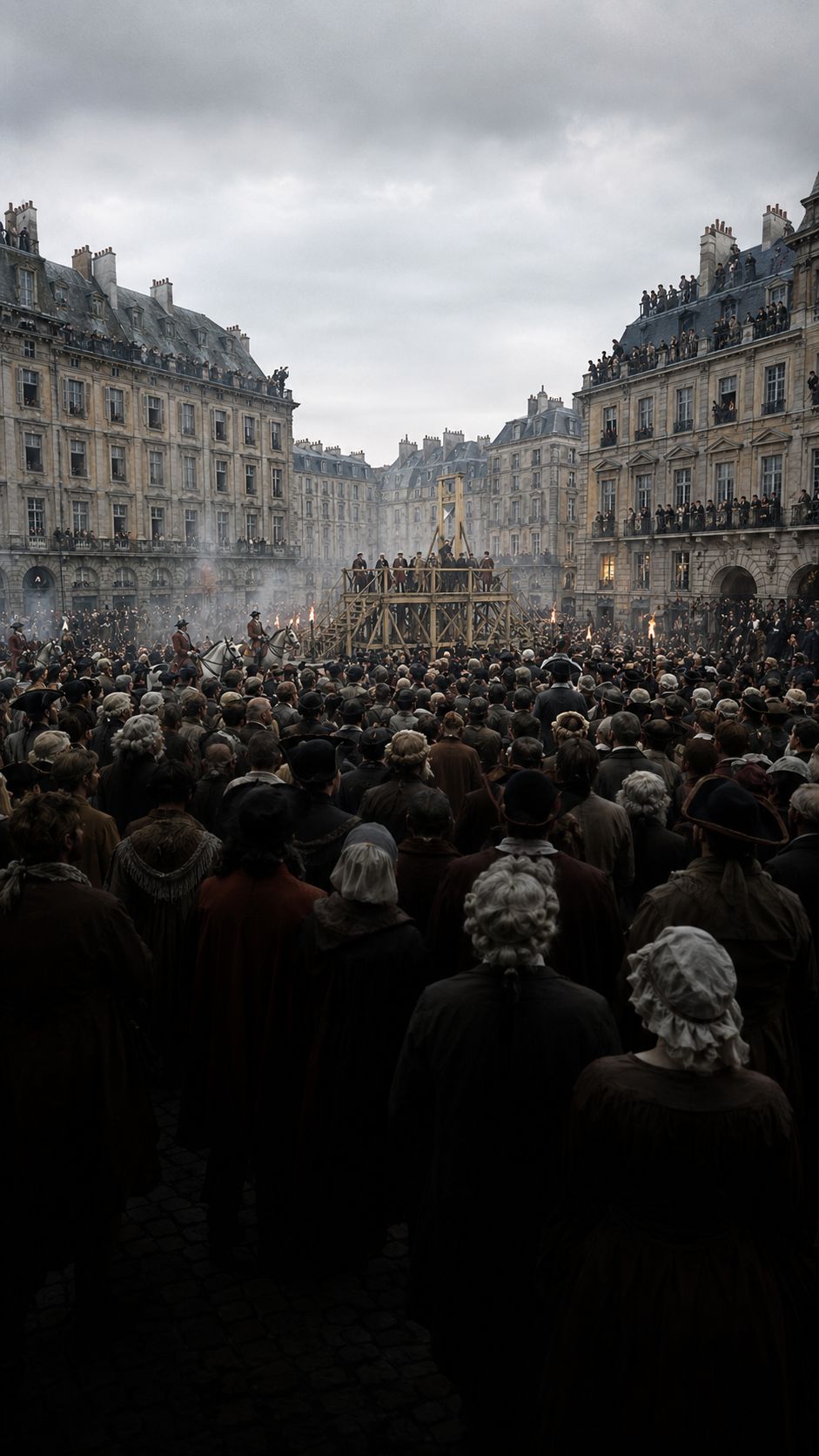
He was convicted on May 6, 1766 and sentenced to beheading. Three days later, on May 9, he was taken to the Place de Grève, the riverside square in front of the Hôtel de Ville where Paris carried out most of its public executions. The sources do not name the place consistently, and one says only “Paris”, but those that do point to the Grève.
Fearing that he would shout his innocence from the scaffold, the authorities gagged him. Wikipedia and Executed Today both report the gag. The second cites the account of Madame du Deffand and a description by Carlyle, and adds handcuffs and a cart. No first-hand description has been found, so those secondary accounts are relied on. The cart is sometimes said to have been a refuse cart. No source for that has been found, and it is left as tradition at best.
The executioner was Charles-Henri Sanson, of the family that held the office for generations. The beheading itself is disputed. One account, cited in Wikipedia through the historian Daniel Arasse, says the first stroke failed to take the head and it came off after four or five blows. The Sanson family memoirs, by contrast, say that Charles-Henri’s first blow failed and that his father finished the work. Wikipedia itself calls that second version “highly unlikely”. So the sound statement is that he was beheaded with the sword while gagged, and that later tradition says it was badly done. The number of blows cannot be confirmed from the available sources.
The Legend and the Record
It is often said that Voltaire took up Lally’s cause out of friendship. That is not the case. Wikipedia says Voltaire disliked Lally but doubted the treason charge. It was Lally’s son, Trophime-Gérard, who approached him in 1770, and who spent years working to rehabilitate the family name. Voltaire could not obtain the trial records at first, and his campaign in print is part of what made the case notorious.
After 32 sessions the Royal Council agreed in 1778 to annul the proceedings. The case was then sent to the Parlement of Rouen, which overturned the sentence in 1781. Wikipedia adds that the conviction itself was never cleared.
The popular telling that Voltaire “wept” on hearing the news and died within days is not what the record gives us. His letter of May 26, 1778 to Lally’s son survives. It is two lines long. He says the news has brought him back to life and that he dies content. It does not mention tears. He did die that same month, but the letter is the only thing to rely on.
Lally’s case entered the argument over French justice in the decades before the Revolution. It was discussed later in the National Assembly’s debate on the guillotine, according to Wikipedia.
The Modern Relic
The Place de Grève no longer exists under that name. It was renamed after 1802 and is now the Place de l’Hôtel-de-Ville, a broad square of about 155 by 82 metres on the right bank, in front of Paris’s city hall and served by the Hôtel de Ville Métro station. Damiens, the would-be regicide, died there, and so did many others. No plaque or monument to Lally on the square has been found.
What survives of the case is on paper. It is in the surviving trial material and in Voltaire’s writing on it, including that short letter of May 1778, which the Voltaire Society has transcribed online. The wooden gag is the detail people remember: a condemned man silenced so that he could not say he was innocent.