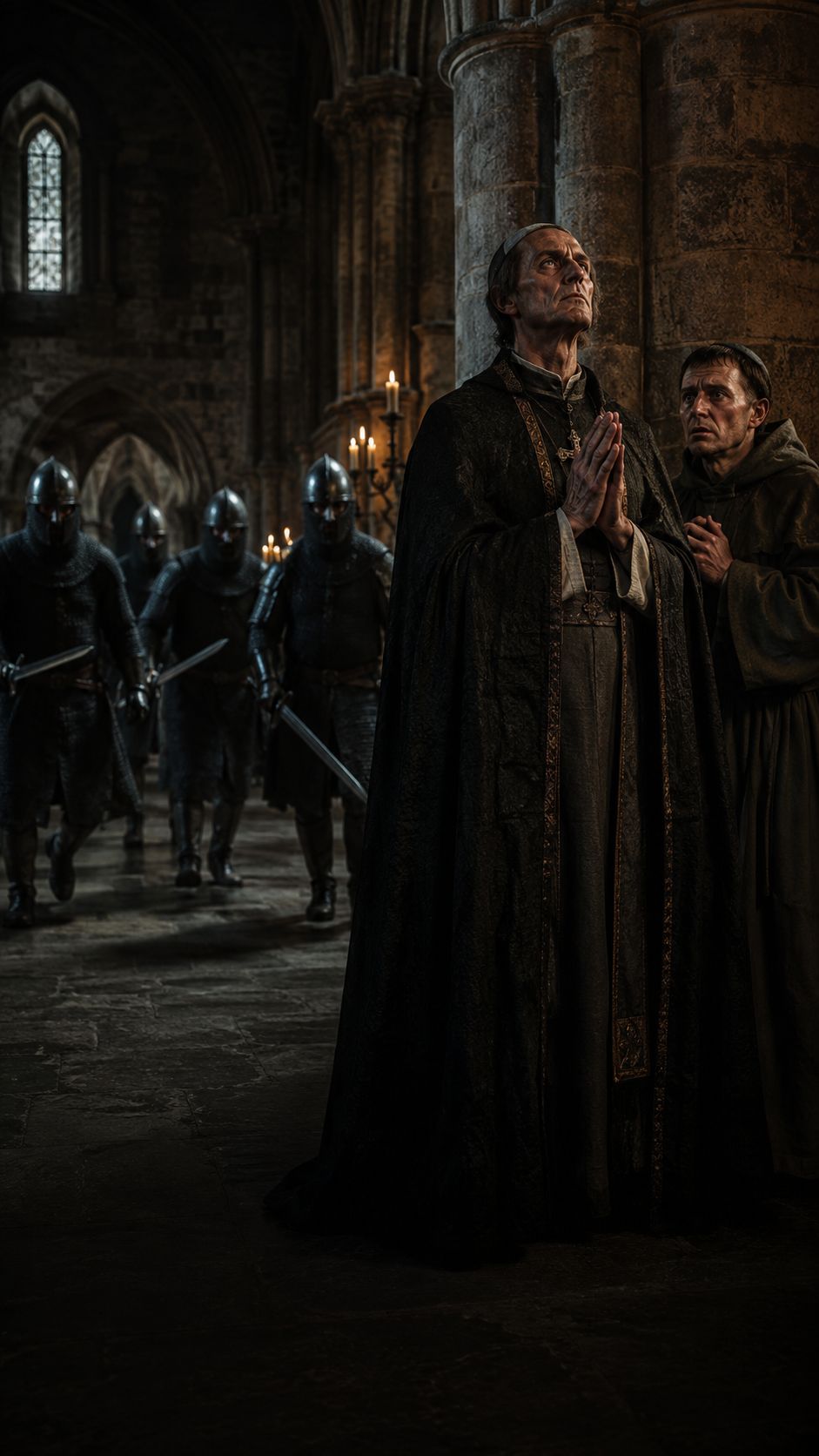
England in 1011 had spent years buying peace from Viking raiders with silver. That autumn the raiders took Canterbury, seized its archbishop and demanded payment for him. The archbishop, Ælfheah, known in English as Alphege, would not let anyone pay. He is remembered for that refusal as much as for the death that followed.
The Horror
A Danish army besieged Canterbury from 8 to 29 September 1011. The city fell with help from inside, through the treachery of a man named Ælfmaer. The cathedral was plundered and burned, and Ælfheah was taken prisoner. He was held for seven months.
The sources agree he refused to allow a ransom to be paid for him. The reasons usually given, that the money would have been wrung from an already impoverished people, are the sympathetic reading of his refusal and not a statement from the Chronicle. The size of the sum demanded is unconfirmed.
He was killed at Greenwich on 19 April 1012. The main account is the E version of the Anglo-Saxon Chronicle. It says the raiders were drunk and pelted him with bones and the heads of cattle. An axe blow to the head ended his life.
The Legend
Later tradition adds a man called Thrum, said to have been a recent Christian convert, who struck the final blow with the back of the axe as a mercy. The Chronicle does not say this, and no source for it is known. A report that the Danish leader Thorkell the Tall offered everything he owned except his ship to save the archbishop is also outside the Chronicle. The life of Ælfheah by Osbern, a Canterbury monk writing generations later, is hagiography with many episodes modelled on the Bible and is weak as evidence.
The Modern Relic
His body was buried in Old St Paul’s. In 1023 Cnut, by then king of England, had it moved to Canterbury with great ceremony. A later tradition, which is uncertain, says Thomas Becket commended himself to Ælfheah shortly before his own murder in 1170.
At Greenwich, St Alfege Church reputedly stands where he died. The present building is by Nicholas Hawksmoor, begun in 1712 after the medieval church collapsed in a storm in 1710, and consecrated in 1718. It is still a parish church of the Church of England. The composer Thomas Tallis, who died in 1585, was buried in the chancel of its medieval predecessor.